

ABOUT
ATLAS (Adaptive Tactical Logistics & Acquisition System) was designed to support military logistics operators in making faster, more informed procurement decisions under mission-critical constraints. From a senior UX research and design perspective, the goal was to transform a traditionally fragmented and time-intensive acquisition process into a streamlined, decision-support experience grounded in real operational workflows.
The system centers on mission context budget, timeline, unit needs, and environment and uses embedded AI to reduce cognitive load by surfacing the most relevant equipment options, flagging risks such as delays or budget overruns, and recommending viable replacements in real time.
Rather than requiring users to manually compare specifications across systems, ATLAS intelligently prioritizes alternatives based on mission fit, historical usage, and logistical constraints, enabling operators to act quickly and confidently. This approach ensures that procurement is not just transactional, but adaptive aligning directly with the dynamic nature of military operations.
Problem
ATLAS (Adaptive Tactical Logistics & Acquisition System)
Designing mission-ready procurement for military operations
Problem
Military logistics operators are responsible for sourcing, evaluating, and procuring mission-critical equipment under strict constraints—budget limitations, delivery timelines, and operational requirements. Existing systems are often fragmented, data-heavy, and unintuitive, forcing users to navigate multiple tools, manually compare options, and make high-stakes decisions with limited support.
This creates:
-
Increased cognitive load
-
Slower procurement cycles
-
Higher risk of selecting suboptimal or delayed equipment
-
Limited visibility into mission impact
There was a clear need for a system that could centralize procurement workflows, reduce friction, and support faster, more confident decision-making.
Approach
I approached ATLAS as a decision-support system, not just a procurement interface. My focus was to design around how logistics operators actually think and work in operational environments—prioritizing speed, clarity, and trust.
Key design principles:
-
Mission-first context (not item-first browsing)
-
High information density with clear hierarchy
-
Familiar military system patterns (tables, modules, structured layouts)
-
Reduced cognitive load through guided workflows
-
Accessibility and 508 compliance as a baseline, not an afterthought
I also embedded AI-assisted interactions to shift the experience from manual searching to intelligent recommendation—helping users quickly identify the best options without needing to analyze every variable themselves.
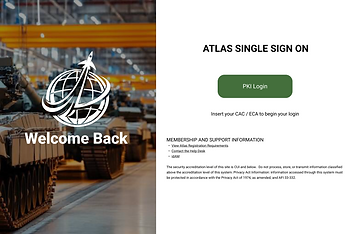
Verification Page (PIV)
The verification page establishes secure, role-based access through CAC authentication, ensuring only authorized personnel can access mission-critical procurement tools. It reduces friction by pre-populating user data such as rank, unit, and permissions, allowing users to quickly enter the system without redundant input. This supports ATLAS’s goal of efficiency and accuracy from the very first interaction.
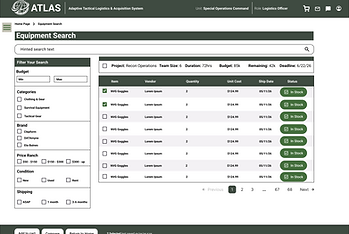
Search & Filter
The search and filter experience allows users to locate mission-specific equipment using constraints such as budget, timeline, vendor, and technical compatibility. AI-enhanced filtering surfaces the most relevant items and flags potential risks, reducing the need for manual comparison. This helps users find the right equipment faster while staying aligned with mission requirements.
Compare
The comparison view enables side-by-side evaluation of equipment options based on cost, delivery time, and mission fit. AI-driven insights highlight the most optimal choice, helping users quickly understand trade-offs without deep manual analysis. This accelerates decision-making while increasing confidence in procurement selections.

Home Dashboard
The dashboard serves as the operational hub, providing immediate visibility into mission context, budget status, recent requests, and pending actions. It is designed for rapid scanning, enabling users to quickly assess priorities and navigate to key workflows without unnecessary steps. This directly supports decision-making under time constraints by centralizing critical information.

Side Menu Navigation
The side menu provides consistent, predictable navigation across core system functions such as procurement, requests, and reporting. Its structured layout mirrors familiar military systems, reducing the learning curve and supporting efficient task switching. This ensures users can move seamlessly between workflows without losing context.

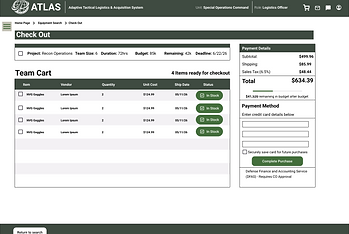
Check Out
The checkout screen consolidates selected items, calculates total cost, and visualizes budget impact before final submission. It provides a clear, auditable summary of the transaction while ensuring compliance with financial constraints and approval workflows. This reinforces accountability and enables users to complete procurement actions quickly and accurately.
Impact
ATLAS transforms procurement from a fragmented, reactive process into a streamlined, mission-aligned workflow.
It:
-
Reduces time to identify and replace equipment
-
Improves decision accuracy under constraints
-
Centralizes procurement visibility
-
Supports operational readiness through better resource alignment
Reflection
This project reinforced the importance of designing for real-world environments, not ideal conditions. Military users are not exploring—they are executing. Every interaction must support speed, clarity, and trust.
By grounding the design in familiar system patterns and augmenting it with AI-driven insights, ATLAS balances usability with operational rigor, creating a system that feels both intuitive and mission-ready.